
Hot Rod Restoration vs. Classic Car Restoration: How Sharpy's Differs

Typing "hot rod shop near me" into a search bar seems straightforward until you realize that not every shop speaking the language of classic cars actually understands the fundamental differences between building a hot rod and restoring a vintage vehicle to factory spec. These are not interchangeable disciplines. One demands creative fabrication, performance integration, and personal expression. The other demands documented accuracy, structural integrity, and period-correct authenticity. Treating them as the same project leads owners to the wrong shop, the wrong budget conversation, and often the wrong outcome entirely.
At Sharpy's, both disciplines share a roof, but they never share a planning process. The fabrication demands differ. The paint and finishing expectations differ. Even the first conversation you have with a builder differs significantly depending on which path you are on.
This post breaks down exactly where hot rod builds and classic restorations diverge, covers the four industry-recognized restoration categories, and gives you a practical framework for identifying which build is actually yours. If you are serious about getting the right result, understanding the distinction before you choose a shop is where that process starts.
Two Disciplines, One Shop, and Why the Difference Matters
The most common mistake owners make is treating "classic car restoration" and "hot rod build" as interchangeable services. They aren't, and choosing the wrong shop for the wrong discipline produces mismatched scope, unexpected costs, and a finished vehicle that doesn't match what the owner had in mind.
Hot rod builds and factory-correct restorations share some equipment and overlap on rust repair, but the goals, fabrication demands, paint planning, and finishing standards diverge completely. One discipline starts with a factory blueprint and works to restore it faithfully. The other starts with an owner's vision and builds toward it, often fabricating components that never existed in any factory.
The industry recognizes four distinct restoration categories: Daily Driver, Street Show, Restomod (Hot Rod), and Concours. Knowing which category your project belongs to before the first shop conversation determines everything that follows, including parts sourcing, fabrication scope, paint approach, and realistic labor expectations.
Sharpy's Rod & Custom has handled both disciplines since 1994 in Denver, drawing on three generations of body-and-paint experience that traces back to 1960. That depth matters because each discipline requires a genuinely different kind of expertise, and the sections below break down exactly where and why they diverge.
What Defines a Hot Rod Restoration Build
A hot rod build starts with a deliberate rejection of factory specification. Where a classic restoration asks "what did this car leave the factory as," a hot rod build asks "what does this owner want it to become." Performance and personal expression drive every decision; period correctness is not part of the brief.
Powerplant choices reflect that freedom directly. Modern crate engines, performance transmissions, and overdrive retrofits are all legitimate options, chosen because they serve the build's intended character, not because they're historically appropriate.
That mechanical freedom creates fabrication requirements with no factory template to follow. Engine mounts, firewall clearance, suspension geometry, and custom panel work must all be designed and built from scratch. Custom fabrication is not an add-on on a hot rod build; it is the build. Shops that subcontract fabrication introduce coordination gaps that cost time and compromise fit.
Interior and exterior choices follow the same logic. Body lines, stance, and paint scheme express the build's character. A color that never appeared on a production window sticker is a feature, not a flaw.
The restomod sits squarely within this tradition: a period-era body carrying thoroughly modern mechanical underpinnings. It blends visual nostalgia with current performance capability, which is why auto restoration work on restomods demands both fabrication skill and a clear aesthetic vision working in parallel.
No two builds should finish looking alike, and that individual ownership over the final result is precisely what defines the discipline.
What Defines a Classic Car Restoration
Classic restoration operates from the opposite premise. Where a hot rod build asks "what should this become," a classic restoration asks "what was this, exactly, and how do we return it there."
Period-correct accuracy is the governing standard. The benchmark isn't a better version of the vehicle; it's the factory version. That distinction shapes every decision, from parts sourcing to paint selection.
The Three Tiers of Classic Restoration
Concours sits at the most demanding end. The target is a "just left the dealership" condition: correct engine block color, date-coded components, factory-spec paint codes, and period-accurate details throughout. Any deviation is a deduction at judged events, making the research workload substantial before any metal is touched.
Street Show restorations occupy practical middle ground. The car reads as visually authentic and structurally correct, but may incorporate modern conveniences like power steering, upgraded brakes, or a refreshed electrical system. Original character stays intact; reliability improves.
Daily Driver restorations go further on the functional side: refreshed motor, upgraded cooling and brakes, modern ignition, power steering. These are vehicles built to be used. Visual originality is preserved; mechanical concessions are made deliberately.
Process Before Paint
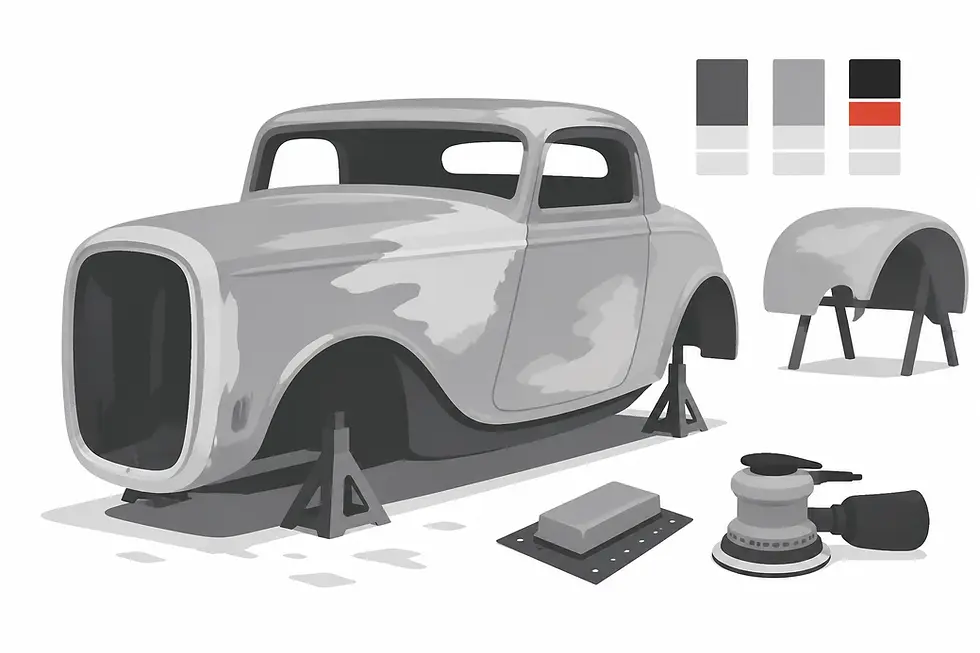
Regardless of tier, the process sequence is non-negotiable. Systematic disassembly with documented labeling comes first; every bracket, clip, and fastener has a correct home, and losing that record costs hours during reassembly.
Structural integrity drives every subsequent decision. Rust repair, frame evaluation, and bare-metal panel restoration precede any cosmetic work. Applying paint over a compromised structure wastes every dollar that follows.
Fabrication Demands: Custom vs. Period-Correct
Where classic restoration fabrication is forensic and constrained, hot rod fabrication is the opposite: open-ended, creative, and defined entirely by the owner's intentions rather than a factory blueprint.
Panel fitting illustrates this cleanly. On a concours or street show build, every gap and body line gets measured against original factory tolerances. The job is matching what was there, not deciding what should be there. On a hot rod, panel fitting may mean fabricating a component that has no OEM reference at all. You're building to a vision, not a specification.
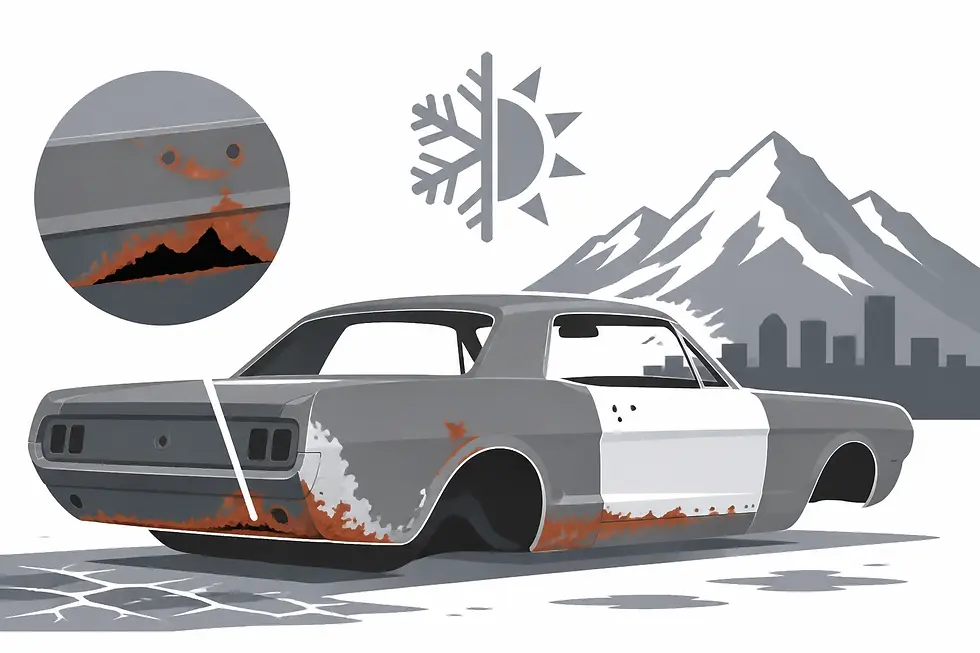
Rust repair is where the philosophical split becomes most practical. Classic restoration treats original metal as something to preserve wherever structurally possible; every repair decision weighs whether the factory sheetmetal can be saved. Hot rod rust repair is less sentimental. If fabricating a replacement section serves the build's direction better than saving compromised original metal, that's the right call.
Suspension work follows the same logic. A hot rod build often requires full geometry changes to accommodate a modern drivetrain, lower ride height, or wider rubber. Classic suspension work means restoring or refreshing the original geometry with quality replacements, not reinventing it.
Because Sharpy's handles fabrication, bodywork, and paint under one roof, these decisions happen together. The fabricator and painter are aligned before metal is cut. That coordination matters more than it sounds. On a complex build, choices made at the metal stage directly affect what's achievable at the paint stage, and finding that out late is expensive.
Paint and Finishing Expectations Differ Completely
The same fabrication discipline that keeps metal honest carries directly into the paint booth, where the two disciplines diverge just as sharply.
Classic restoration paint starts in the archives, not the color deck. The correct factory color code and the finishing approach appropriate for that model year both need to be established before a gun is loaded. At the concours level, authenticity is the governing standard, and deviations from factory specification carry real consequences on the show field and in the restoration community.
Hot rod paint works in the opposite direction. Color selection is a design conversation driven by the owner's vision, not a factory document search. Two-tone layouts, matte metallics, and graphic treatments aren't exceptions on a hot rod build; they're expected outcomes, and executing any of them cleanly requires rigorous panel preparation and disciplined application technique.
Surface preparation is where both disciplines meet. Factory-correct or fully custom, no paint system performs over poorly prepared metal. The standard doesn't change based on build type.
Sharpy's PPG Master Certification covers both ends of this range: factory color matching for period-correct restorations and custom finish work for hot rod and restomod projects. That dual capability is why the certification matters for a Denver shop serving both disciplines under one roof.
How the Planning Conversation Differs for Each Build
Paint decisions and build decisions aren't separate conversations at Sharpy's. They're the same conversation, and it starts differently depending on which discipline is on the table.
For a hot rod owner, the first questions are about vision and intent: What does this car need to do? How should it feel at speed? What's non-negotiable about its final character? Those answers determine everything downstream, including drivetrain selection, which has to happen early. Engine and transmission choices cascade directly into fabrication decisions about motor mounts, cooling capacity, exhaust routing, and firewall clearance. Locking in the drivetrain late creates expensive rework.
For a classic restoration owner, the first question is category: Daily Driver, Street Show, or Concours? That single answer shapes every subsequent choice about parts sourcing, material standards, and labor scope. A Daily Driver and a Concours build can start with identical donor cars and finish as completely different projects in terms of cost, timeline, and process rigor.
After category, classic planning shifts to a detailed condition assessment. Rust extent, panel originality, parts availability, and existing documentation all feed into what a realistic scope actually looks like for that specific vehicle. Scope is set after that assessment, not before.
The friction point comes when owners arrive with mismatched expectations, such as hot rod complexity priced against classic restoration assumptions, or vice versa. A serious shop resolves that in the first conversation, not after work begins.
Bodywork, fabrication, and paint scoped together from the start, not handed off as separate estimates in sequence, is what prevents the gaps that cost owners money and time mid-build.
Which Build Is Yours? A Practical Self-Assessment
Once the planning conversation is framed, the natural next step is placing your specific project in the right category before scope or budget discussions begin.
Two questions cut through most of the uncertainty. First: is preserving this vehicle's documented history and factory correctness the goal? If the answer is yes, the project is a classic restoration. The objective is returning something to what it was, not improving on it. Second: does the vision include a modern drivetrain, custom suspension geometry, or a paint scheme that never left any factory? If yes, that's a hot rod or restomod build, regardless of what the donor vehicle looks like sitting in the garage.
Owners who aren't certain often land in the middle, and that's a legitimate place to be. Street Show and Daily Driver restorations are visually faithful to the original while incorporating mechanical upgrades for reliability. For owners who want a restored car they can actually put miles on, these categories are typically the most practical entry point.
One clarification worth making when searching for a hot rod restoration shop or custom car restoration specialist in Denver: fabrication capability is the differentiator, not bodywork and paint alone. Confirm the shop handles the full scope in-house before committing.
When the category still isn't clear, arrive at the first conversation with photos, whatever documentation exists, and a straightforward answer to how the finished vehicle will be used. That context shapes every recommendation a shop can make.
Why Shop Credentials Matter Differently for Each Discipline
Once you know your project category, the next question is whether a shop can actually execute it.
For hot rod and restomod builds, the credential that matters most is verifiable in-house fabrication capability. Body and paint skills alone are not sufficient. A legitimate hot rod restoration shop can build custom components, modify suspension geometry, and integrate modern drivetrains without subcontracting the parts that define the build.
For classic restoration, period-correct accuracy depends on factory specifications, original documentation, and paint certification that supports precise color matching, covered by Sharpy's PPG Master Certification, which spans factory color accuracy across production eras rather than approximating from memory.
Sharpy's I-CAR Certification confirms a structural repair discipline that applies to both hot rod and classic restoration work, understanding how repair decisions made early propagate through the rest of the build. That certification is the reason factory color accuracy is part of the same conversation as fabrication planning, not a separate engagement.
Sixty-six years of family body-and-paint experience spanning three generations is a factual record, not a tagline. It means Sharpy's has worked through production eras many shops have never encountered, from pre-muscle-car classics through late-model restomods.
A general collision repair shop serves a different function. Volume-driven turnaround and insurance workflow are not restoration practice. Owners who want someone who understands what their vehicle is supposed to be should look for a shop built around that purpose.
Sharpy's backs restoration work with a 3-year warranty, reflecting process confidence across bodywork, fabrication, and paint treated as a single integrated scope. For questions about where your project fits, Restoration, Collision & Paint Inquiries is the starting point.
Start With the Right Conversation
Credentials confirm a shop can do the work. The conversation you have before any metal moves determines whether it's the right work for your specific build.
As covered above, the four categories, Daily Driver, Street Show, Restomod/Hot Rod, and Concours, let a shop give you an accurate scope rather than a ballpark built on assumptions.
Sharpy's handles the full range of builds under one roof in Denver: in-house fabrication, PPG Master Certified paint, and I-CAR Certified structural work. That combination serves a factory-correct concours build and a fully custom restomod through the same integrated process, bodywork, fabrication, and paint planned together from the start.
Bring photos, any documentation you have, and a clear picture of how you intend to use the finished vehicle. Call 303-920-9330 or request a free estimate, and Sharpy's will help you place your project in the right category before any commitments are made.
Conclusion
Three points stay consistent across every project at Sharpy's: fabrication, bodywork, and paint are planned as a single integrated scope; credentials matter differently depending on your build category; and the right conversation before work begins determines everything that follows.
Bring your photos, your documentation, and your vision. Call 303-920-9330 or request a free estimate. The right build starts with the right conversation.

Comments