
Paint Color Matching for Classic Cars in Denver: How Sharpy's PPG Process Restores Discontinued Factory Colors

Getting a classic car back to its original factory color sounds straightforward until you realize the paint code on your door jamb was never designed to survive fifty years of Colorado sun, altitude, and pigment drift. For owners searching for reliable classic car painting near me, the technical reality is harder than most shops will admit: 1960s and 1970s American factory colors were formulated in discontinued paint systems that have no direct equivalent in modern chemistry. You cannot simply look up a code, order a can, and expect an accurate result.
Restoring a factory color correctly requires spectrophotometry, certified mixing, and an understanding of how original pigments aged under specific environmental conditions. This analysis breaks down exactly why that process is more demanding than applying a custom finish, what a spectrophotometer actually measures and where its limitations begin, and what PPG Master Certified status means in practical terms for a restoration client. You will also find a step-by-step look at how Sharpy's approaches discontinued OEM colors, why Denver's climate introduces variables other regions do not face, and what questions you should ask any shop before committing your restoration to their process.
Why Factory Color Restoration Is Technically Harder Than a Custom Finish
A custom finish is a defined problem: choose a color, formulate it, apply it. Factory color restoration is different. The target, a pigment formulation from 50-plus years ago, no longer exists in any current database in its original form. The job is reverse-engineering something never designed to be reproduced in a different chemistry era.
That chemistry gap is the core obstacle. American factory colors from the 1960s and 70s were produced in paint systems that have since been discontinued, chemistries whose pigment structures do not translate directly into modern waterborne and solvent-borne basecoat-clearcoat refinish formulations. The molecular behavior of those original pigments under light, heat, and time does not translate directly into modern refinish chemistry. Something is always lost in the conversion.
The paint codes survive, but they do not preserve the original formulation. Many iconic muscle car colors from this era exist in modern databases only as reverse-engineered estimates, not direct encodings of the original pigment recipe. The code references the color family; it does not reconstruct the original spectral character of a finish from that era. That distinction matters when the standard is restoration accuracy rather than close enough.
The deeper challenge, as detailed in our automotive paint services, is translating a pigment formulation across 50 years of chemistry evolution, material changes, and UV-driven spectral drift.
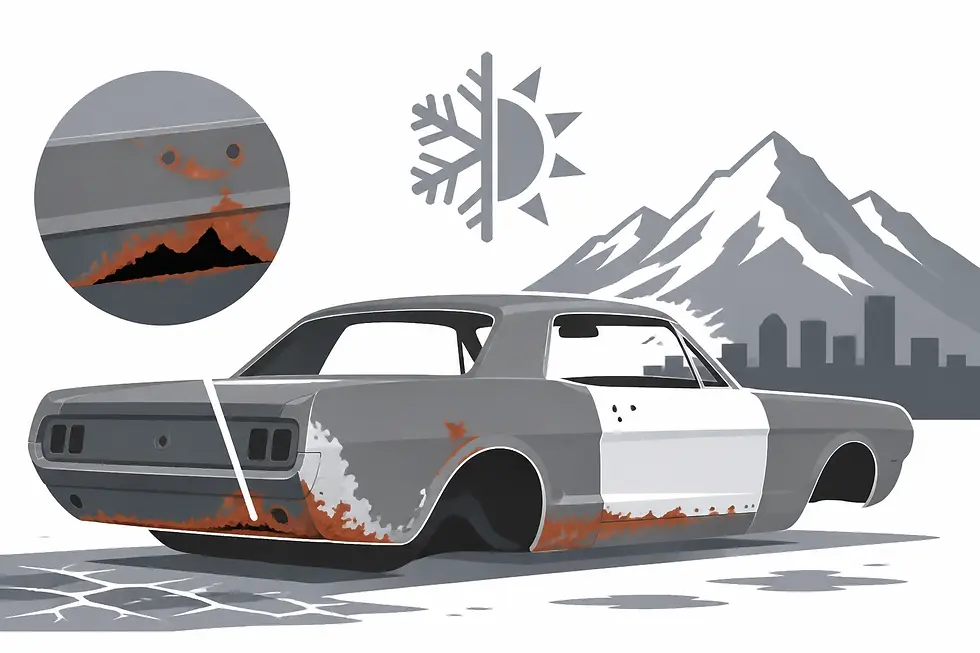
Denver compounds every variable. At 5,280-plus feet with consistently high annual sunshine hours, Colorado's UV exposure is among the most aggressive in the continental United States. Classic cars that spent decades here show measurable color shift even on panels that appear well-preserved. The reference point itself has moved.
Why the Code on Your Door Jamb Is a Starting Point, Not an Answer
That code on your door jamb is real information, but it answers a narrower question than most owners expect.
The code identifies the color family and the OEM intent at the time of production. It does not give a certified mixer a working formula. The paint system it references has not been manufactured in decades. Modern databases hold reverse-engineered estimates of those original formulations, not direct copies.
There is also a production-era consistency problem that rarely gets mentioned. Two cars with identical codes, same year and model, could leave different assembly plants with measurably different actual color due to batch-to-batch pigment variation, differing spray booth conditions, and primer differences across facilities. The code was never a guarantee of uniformity on the line. It is certainly not one now.
For Colorado cars specifically, UV exposure adds another layer of separation between the code and the car. The color on your exposed panels today is not the color the car left the factory wearing. Matching the door jamb code in that condition would reproduce a color the car never actually displayed in its current state.
The code is where the diagnostic process begins. A certified mixer uses it as orientation, then cross-references it against what the car's surface actually reads before any formula gets built.
What a Spectrophotometer Actually Does (and What It Cannot Do Alone)
Once you understand that the door jamb code is a starting point rather than a formula, the next question is what tool actually does the diagnostic work. That tool is the spectrophotometer.
A spectrophotometer is a handheld scanner that reads a painted surface by measuring how light reflects across multiple wavelengths simultaneously. The result is a precise spectral profile of the panel as it currently exists, not an approximation based on visual judgment. That profile is then compared against global formulation databases containing thousands of paint variants, returning ranked candidate formulas in minutes rather than the hours a trained eye would require working alone.
Where the Technology Reaches Its Limit
For modern vehicles, that workflow, scan plus database lookup, is often sufficient. The formulations are current, the databases are complete, and the car's surface color is reasonably close to its original factory specification.
For a 1960s or 1970s classic, the same process routinely breaks down. The database may return no viable match, a heavily degraded match, or a match calibrated to the car's current faded condition rather than its original factory color. That is a critical distinction. Spectrophotometer data tells a certified mixer precisely where the car is today. It does not tell them where the car started.
Bridging that gap requires expertise in how specific pigment families age, oxidize, and shift spectrally over decades. The instrument's output is input to an expert judgment call, not a final answer, color matching combines technical measurement with trained interpretation.
For discontinued factory colors, a certified mixer must cross-reference spectral readings against surviving reference cars, period paint chip archives, and documented drift patterns for the specific color family before building a custom-mixed auto paint formula from component pigments.
What PPG Master Certified Actually Means for Classic Car Restoration
That expert judgment call requires the right infrastructure to act on. That is where manufacturer certification becomes operationally relevant, not just credentialing.
PPG Master Certified is a manufacturer-level credential, not a self-awarded designation. According to PPG's refinish program, certified shops operate manufacturer-validated spectrophotometers and mixing equipment held to the system's quality standards. The meaningful distinction is what that equipment can access: an uncertified shop working from a paint counter buys pre-mixed colors keyed to current stock codes. A PPG Master Certified shop builds formulas from component pigments, working from the system's formulation infrastructure directly.
For classic car restoration specifically, that infrastructure matters because PPG's refinish system provides access to extensive formulation databases and component-level custom mixing, which certified shops use when stock codes return no viable match. When a stock code returns no viable match or returns a degraded approximation of a 1960s factory color, a certified shop has the tools to construct a formula from the ground up rather than default to the closest available option.
Sharpy's holds PPG Master Certified status and brings extensive body-and-paint experience in Denver, meaning that infrastructure is paired with hands-on mixing experience specific to how these colors have aged in Colorado conditions. For a Denver classic car owner evaluating a PPG's certification program, the certification is a verifiable quality signal because it is validated by the manufacturer of the system, not by the shop describing its own process.
How Sharpy's Approaches Discontinued OEM Colors: The Step-by-Step Process
That certification is only as useful as the process behind it. Here is how that process runs on a discontinued OEM color job.
Step 1: The door jamb code orients the mixer, identifying color family and OEM intent as the starting reference, not the formula.
Step 2: Spectrophotometer readings are taken from multiple panels, with deliberate attention to protected surfaces: under trim strips, inside door edges, beneath badges. These shielded areas retain paint that has seen less UV exposure, giving the mixer a closer read on what the factory color actually looked like than any exposed panel can provide on a Colorado car.
Step 3: The spectral data is cross-referenced against PPG's historical formula libraries. Where available, that data is also compared against period paint chip archives and surviving factory-original examples of the same color. The goal is triangulating the original factory target, not just recording the car's current condition.
Step 4: The certified mixer builds a custom-mixed formula from component pigments, adjusted for the known spectral drift characteristics of that color family and calibrated to the target restoration standard: concours accuracy, daily-driver quality, or matching surviving original panels on the same car.
Step 5: Spray-out verification happens before anything touches the car. The mixed color is sprayed and cleared on test panels, then evaluated under direct sunlight and artificial light at multiple angles. A color that matches under one light source and shifts under another does not pass.
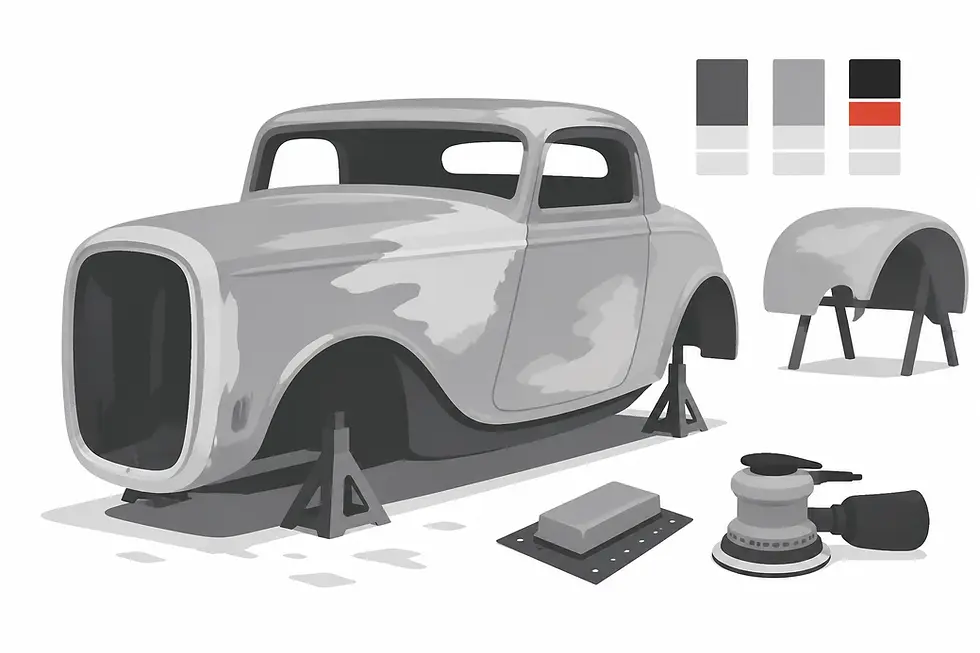
Step 6: Final application is coordinated across the whole project. Because bodywork, fabrication, and paint happen under one roof at Sharpy's, the color matching process accounts for panel prep, primer selection, and application conditions from the start rather than treating paint as a task that follows everything else.
The Colorado Factor: How Denver's Altitude and Sun Affect Classic Car Paint
Denver's altitude and sun load, covered briefly in the opening sections, deserve closer examination because they affect both how classic car paint has aged and how fresh paint must be applied.
Denver's combination of elevation and consistently high annual sunshine hours creates one of the more UV-intensive automotive environments in the inland West. The physics are straightforward: UV radiation increases with altitude because there is less atmosphere to filter it. At Denver's elevation, the difference is measurable and cumulative over a car's lifetime.
For automotive finishes, UV exposure triggers photodegradation: UV rays penetrate the clearcoat and cause oxidation, bond cleavage, and pigment fragmentation at the molecular level. A classic car that has spent decades parked and driven in Denver has experienced that process on an accelerated timeline compared to the same car in a lower-elevation state. Exposed panel surfaces may have shifted significantly from factory spec, while protected areas under trim and beneath badges retain something closer to the original color.
That divergence is operationally useful. It also means a shop without Colorado experience may not recognize how far a specific pigment family drifts under local conditions, or how to weight protected-area readings against the exposed surface when building a restoration formula.
Altitude can also affect paint application, spray behavior and solvent evaporation rates change above 5,000 feet, meaning a formula and technique calibrated elsewhere may perform differently in Denver conditions. That is not a problem a shop can troubleshoot from a distance.
Three Generations of Body-and-Paint: Why Experience Matters in Color Matching
Local altitude and UV exposure is one part of the equation. The other is what the people reading spectral data actually know about the cars they're working on.
Sharpy's Rod & Custom was founded in Denver in 1994 by Marc Sharp, but the family's body-and-paint history runs back to 1960. That's 66 years across three generations, meaning the shop's institutional knowledge predates most of the cars they now restore. The people interpreting a spectrophotometer reading on a 1969 muscle car have been studying how those cars age since before those cars were old.
That distinction matters technically. Matching a discontinued factory color is not a pure technology problem. Spectral data tells you where the car is today. Knowing where it started, how the original paint was applied at the assembly plant, and how that pigment family behaves over 50 years of aging, that knowledge doesn't come from a database. It accumulates through years of working on the cars themselves.
Marc's son Beau now works alongside him. That continuity informs judgment calls about formula adjustment and application approach that a shop with only modern collision repair experience would handle differently.
I-CAR Certification and PPG Master Certified are both externally awarded credentials, neither is self-designated.
For a Denver classic car owner researching a serious restoration shop, meet the Sharp family behind the work before you commit to anyone.
What to Ask Any Classic Car Paint Shop Before You Commit
That experience and credibility only matter if you can verify it before you hand over a car. These questions cut through shop claims quickly.
Does the shop use a manufacturer-validated spectrophotometer and certified mixing system? Off-the-shelf color codes pulled from a database are not a custom-mixed auto paint process. A shop should name its certified refinish system, whether PPG, Axalta, or another manufacturer-validated platform, and explain how it calibrates that equipment.
How does the shop handle a color with no viable database match? This is the diagnostic question for discontinued factory colors. A qualified shop describes building a formula from component pigments, cross-referenced against period paint chip archives or surviving reference cars. "We'll use the closest stock color" is the wrong answer.
Is spray-out verification standard before the car is painted? The mixed formula should be sprayed onto a test panel, cleared, and evaluated under multiple light sources including direct sunlight before touching the vehicle. Its absence is a meaningful quality signal.
How does the shop handle panels with different fade profiles on the same car? Adjacent panels exposed to different amounts of Colorado sun will have shifted unevenly. Blending to adjacent panels and clearing across panel boundaries is the correct approach where batch variation already exists.
For Denver owners searching for classic car painting near me, proximity is not the filter. Certified mixing infrastructure, local altitude application experience, and a restoration-specific process are. Start with a restoration and paint inquiry at Sharpy's and bring these questions with you.
Getting a Discontinued Factory Color Right: The Bottom Line
Restoring a 1960s or 1970s factory color is a reverse-engineering problem. The door jamb code establishes intent; it does not resolve the job. The actual formula has to be reconstructed from spectral data, reference cross-checking, and the certified mixer's interpretation of how that specific pigment family has shifted over 50 years.
The process that produces accurate results combines three distinct capabilities: spectrophotometry for diagnostic foundation, PPG Master Certified mixing for execution, and Denver-specific application knowledge to translate lab accuracy into a finish that holds at 5,280 feet under Colorado sun. Any one of those without the others leaves a gap.
That full process, spectral diagnostics, custom mixing, spray-out verification, and coordinated bodywork, is what separates restoration from approximation.
Sharpy's free estimate begins with an in-person assessment of your car's current color condition, the door jamb code, and the restoration standard you're working toward. That conversation shapes every technical decision that follows. Call 303-920-9330 to schedule yours.
Conclusion
The full process and the experience behind it are detailed above; bring your questions to Sharpy's and schedule a free in-person estimate.
Your classic car deserves a finish that honors the original factory intent. Schedule your free in-person estimate today by calling 303-920-9330 or visiting Sharpy's contact page. Bring your questions. Leave with a clear path forward.

Comments